
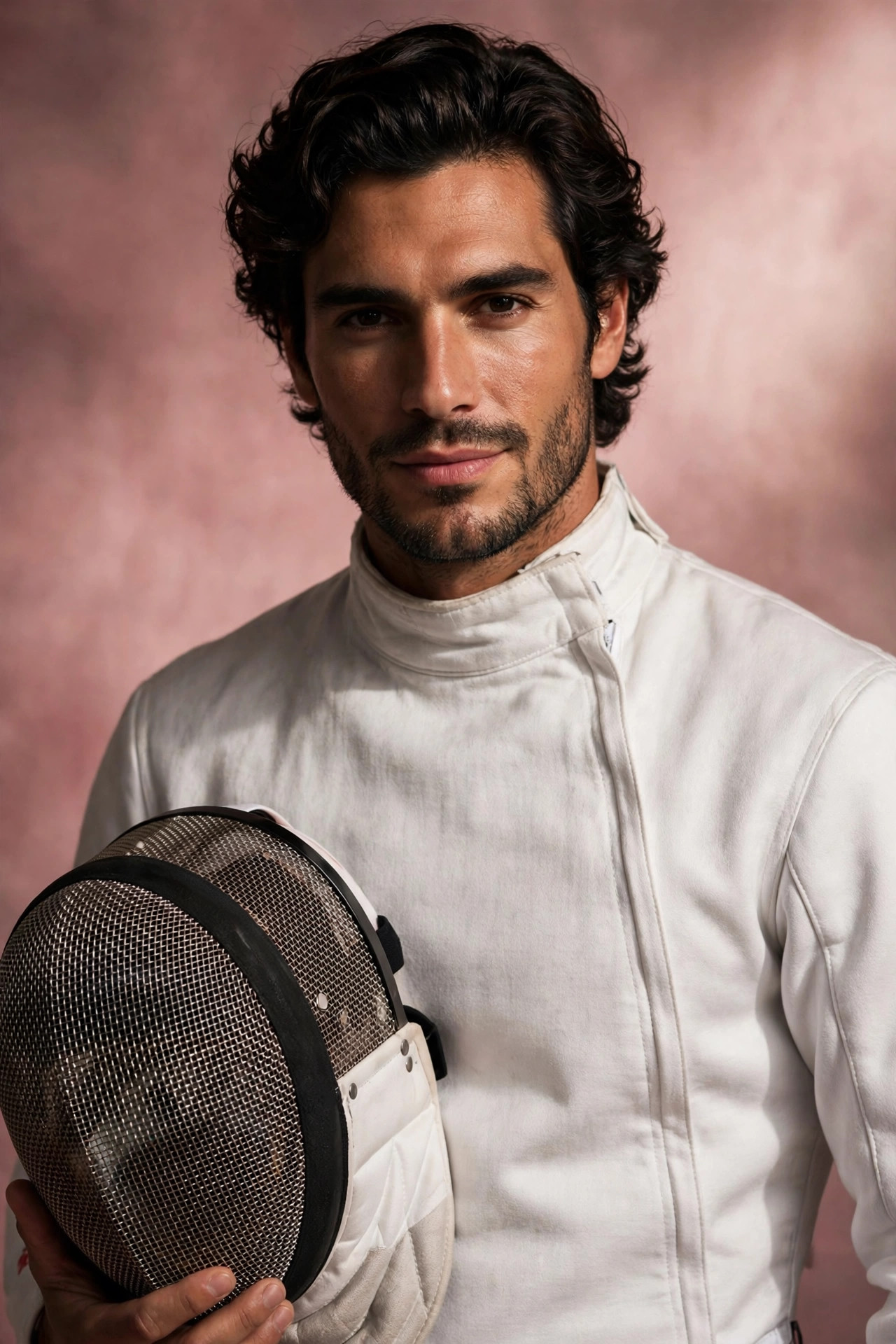
Cesar De Diego was a Spanish fencer who carried his country’s colors to the Olympic Games at a time when Spain’s presence in the sport was still finding its footing. A specialist in the sabre — the fastest and most aggressive of the three fencing weapons — he spent the late 1950s and early 1960s competing against the finest blades in Europe, earning a Mediterranean Games silver medal and a place on Spain’s fencing team at the 1960 Rome Olympics.
Born in Oviedo, the historic capital of Asturias in northern Spain, on June 18, 1924, De Diego grew up in a country rebuilding itself, and fencing — a sport of discipline, precision, and aristocratic tradition — became his lifelong pursuit. Though he never became a household name outside fencing circles, his career represents an important chapter in Spanish Olympic history, and his story deserves to be remembered by more than the record books.
This complete biography covers everything about Cesar De Diego — his wiki, age, height, weight, career journey, relationship status, net worth, and ten interesting facts you may not know about one of Spain’s pioneering Olympic fencers.
Cesar De Diego Wiki and Biography
| Attribute | Details |
| Full Name | César de Diego (anglicized as Cesar De Diego) |
| Date of Birth | June 18, 1924 |
| Date of Death | July 2015 (aged 91) |
| Birthplace | Oviedo, Asturias, Spain |
| Nationality | Spanish |
| Ethnicity | Not publicly documented |
| Zodiac Sign | Gemini |
| Profession | Olympic fencer (sabre specialist) |
| Years Active | Competitively approx. late 1950s – early 1960s |
| Relationship Status | Not publicly documented |
Height, Weight and Physical Appearance
Fencers of De Diego’s era were valued less for physical size than for reflexes, timing, and tactical intelligence — qualities that made the sabre one of the most demanding weapons to master. Unfortunately, no official height or weight measurements for Cesar De Diego survive in the public record, which is typical for Olympic athletes of the mid-20th century, when athlete biometrics were rarely published outside official programs.
| Attribute | Details |
| Height | Not publicly documented |
| Weight | Not publicly documented |
| Body Measurements | Not publicly documented |
| Eye Color | Not publicly documented |
| Hair Color | Not publicly documented |
| Shoe Size | Not publicly documented |
| Distinctive Features | Athletic fencer’s build; remembered in competition photographs in classic white fencing whites |
Career
Cesar De Diego’s competitive career unfolded during a fascinating transitional period for Spanish sport. In the 1950s, Spain was still a relatively minor player in Olympic fencing, dominated as the sport was by the traditional powers of France, Italy, Hungary, and the Soviet Union. To qualify for an Olympic fencing team from Spain at that time required not only talent but extraordinary dedication, since the training infrastructure was far thinner than in the fencing heartlands.
De Diego’s breakthrough at the international level came at the 1959 Mediterranean Games in Beirut, Lebanon. There, competing for Spain in the team sabre event, he helped his squad fight its way to a silver medal — a landmark result that announced Spain’s growing competence in a sport where it had historically been an outsider. For a fencer from Oviedo, standing on a Mediterranean Games podium was the validation of years of unseen work on the piste.
The following year brought the pinnacle of any athlete’s career: the Olympic Games. At Rome 1960, Cesar De Diego represented Spain in both the individual sabre and team sabre competitions. The sabre field in Rome was stacked with legends, and advancing deep into the rounds was a brutal proposition for a fencer from a non-traditional fencing nation. Regardless of his final placement, simply wearing the Spanish colors on the Olympic piste placed De Diego among the elite of his era’s fencers.
After his Olympic appearance, De Diego stepped back from the international spotlight, as most amateur athletes of his generation did — returning to ordinary life after a career built on unpaid dedication to a sport he loved. He lived to the age of 91, passing away in July 2015, long enough to see fencing evolve into the electrified, televised spectacle it is today.
| Attribute | Details |
| Profession | Olympic fencer (sabre) |
| Career Started | Not publicly documented; competitive internationally by the late 1950s |
| Known For | Representing Spain in sabre at the 1960 Rome Olympics; Mediterranean Games team sabre silver medalist (1959) |
| Teams / Organization | Spain national fencing team |
| Notable Milestones | Mediterranean Games silver, team sabre (Beirut 1959); Olympic individual and team sabre competitor (Rome 1960) |
Net Worth
No reliable net worth figure exists for Cesar De Diego. As an amateur athlete competing in the 1950s and 1960s — an era when Olympic fencers received no prize money, endorsements, or professional salaries — he would not have earned wealth from his sport. One public biography database estimates his net worth at approximately $5 million, but this figure is low-reliability, was published after his death, and has not been independently verified, so it should be treated as an estimate only.
His income during his lifetime came from his professional life outside fencing, details of which are not publicly documented.
| Attribute | Details |
| Net Worth (estimated) | ~$5 million (estimated; low-reliability figure) |
| Income Sources | Professional career outside sport (not publicly documented) |
10 Interesting Facts About Cesar De Diego
- Cesar De Diego was one of the relatively few Spanish fencers of his generation to reach the Olympic Games — a significant achievement for a country outside the sport’s traditional power centers.
- He was born in Oviedo, the historic capital of Asturias in northern Spain, a region better known for football than fencing.
- His weapon was the sabre — the fastest of the three fencing weapons and the one with the most aggressive, slashing style of play.
- He won a silver medal in the team sabre event at the 1959 Mediterranean Games in Beirut, Lebanon.
- He competed at the 1960 Summer Olympics in Rome in both the individual sabre and team sabre events.
- His Olympic appearance came at the age of 36 — an age when many fencers are already past their peak, which speaks to his longevity in the sport.
- The Rome 1960 fencing competition was held at the Palazzo dei Congressi, a venue built for the Games in the EUR district.
- He was a Gemini, born on June 18, 1924 — a date he shared with an era of Spanish sporting pioneers.
- He lived to 91, passing away in July 2015, meaning he witnessed more than six decades of evolution in his sport after hanging up his mask.
- His Mediterranean Games silver remains one of the notable early Spanish fencing medals in the post-war era of the competition.
Conclusion
Cesar De Diego’s name may not echo through the halls of sporting fame, but his story is the story of thousands of dedicated amateur athletes who built the Olympic movement with nothing but discipline and love for their craft. From Oviedo to the podiums of Beirut and the Olympic piste of Rome, he carried Spanish fencing forward at a time when few were watching — and that quiet contribution is exactly what makes his biography worth telling.
FAQs About Cesar De Diego
Q: Who is Cesar De Diego?
A: Cesar De Diego (1924–2015) was a Spanish Olympic fencer who specialized in the sabre. He represented Spain at the 1960 Rome Olympics and won a Mediterranean Games silver medal in team sabre in 1959.
Q: What is Cesar De Diego’s real name?
A: His name is recorded as César de Diego in official Olympic records; “Cesar De Diego” is the anglicized form.
Q: How old was Cesar De Diego?
A: He was born on June 18, 1924, and died in July 2015 at the age of 91.
Q: What is Cesar De Diego’s height and weight?
A: His height and weight are not publicly documented — typical for Olympic athletes of the 1950s and 1960s, when athlete biometrics were rarely published.
Q: What did Cesar De Diego do for a living?
A: He was an Olympic fencer competing as an amateur for Spain. His professional career outside fencing is not publicly documented.
Q: Where is Cesar De Diego from?
A: He was born in Oviedo, Asturias, Spain, and competed internationally for Spain.
Q: What is Cesar De Diego’s net worth?
A: No reliable figure exists. One public biography database estimates around $5 million, but this is a low-reliability, unverified figure that should be treated as an estimate only.
Q: Was Cesar De Diego married, or did he have a girlfriend?
A: His relationship status is not publicly documented.
Q: What is Cesar De Diego known for?
A: He is known for representing Spain in individual and team sabre at the 1960 Rome Olympics and for winning a team sabre silver medal at the 1959 Mediterranean Games in Beirut.
Q: When did Cesar De Diego die?
A: He died in July 2015 at the age of 91.
Last Updated: October 2026 | Fact-checked by the Xposed editorial team.