
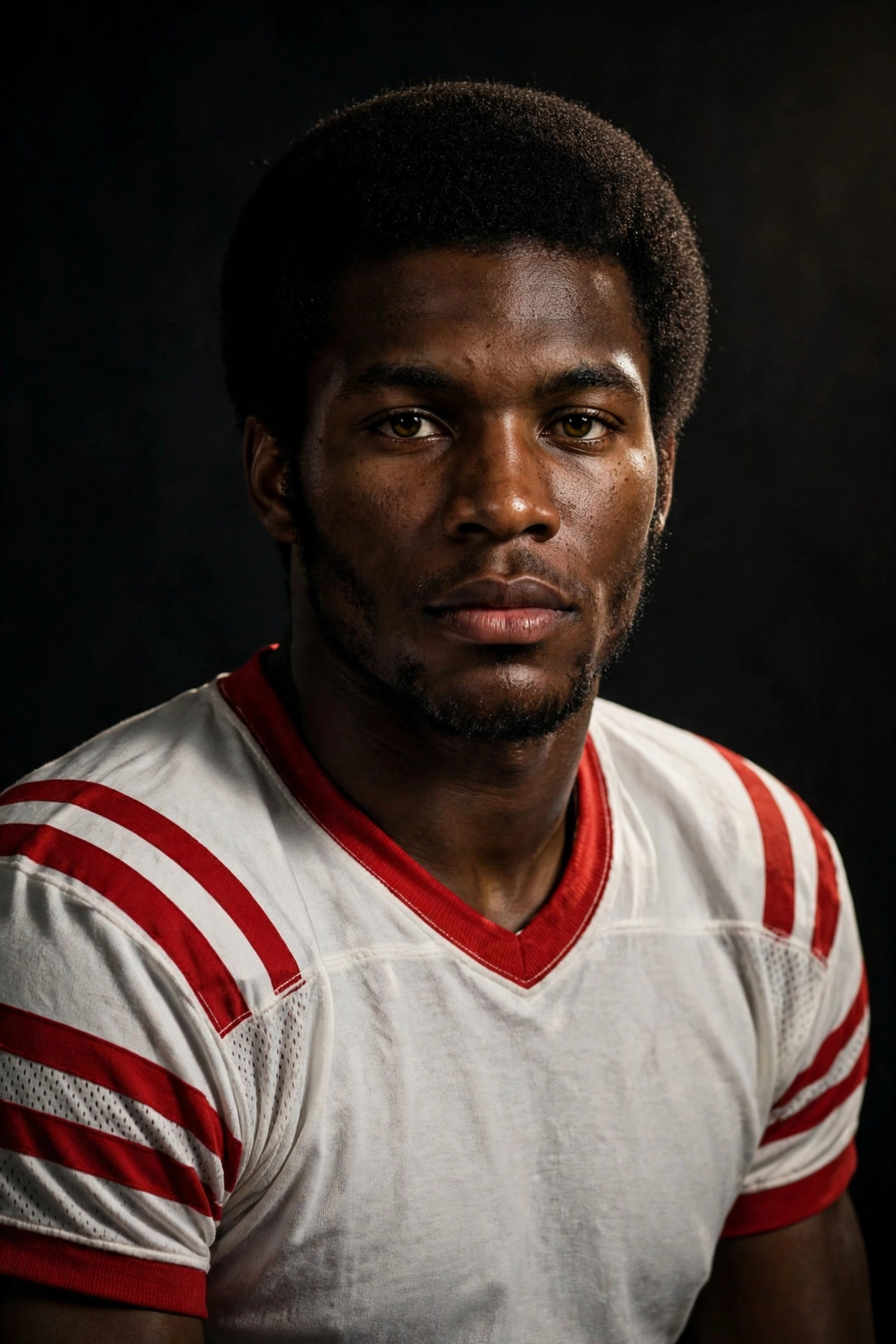
Darryl Stingley’s name is inseparable from one of the most discussed moments in American football history — the August 1978 preseason hit that left the young New England Patriots wide receiver a quadriplegic. But Stingley was far more than a cautionary tale. He was a first-round draft pick, a five-season NFL starter, a man who rebuilt his life after tragedy with remarkable dignity, and the grandfather of a future Houston Texans star. His story runs from the playgrounds of Chicago’s South Side to the NFL, from a hospital bed to a memoir, and into a legacy that changed how football protects its players.
Before the injury, Stingley was building a career that had the league taking notice. Drafted 19th overall in 1973 out of Purdue, he caught 110 passes for 1,883 yards and 14 touchdowns over five seasons, and on the day his career ended he had just negotiated a contract extension that would have made him one of the highest-paid receivers in the game. What happened next — the collision with Oakland Raiders safety Jack Tatum on 12 August 1978 — compressed his spinal cord, broke two vertebrae in his neck, and put him in a wheelchair for the remaining 29 years of his life.
This biography tells the complete story of Darryl Stingley — his Chicago childhood, his rise through high school and Purdue, his Patriots career, the fateful hit and its aftermath, his life after football, his physical stats, his family, and his estate’s estimated worth.
Darryl Stingley Wiki and Biography
| Full Name | Darryl Stingley |
|---|---|
| Known As | Darryl Stingley; “The Stinger” |
| Date of Birth | 18 September 1951 |
| Date of Death | 5 April 2007 (aged 55) |
| Birthplace | Chicago, Illinois, United States |
| Place of Death | Chicago, Illinois, United States |
| Nationality | American |
| Ethnicity | Not publicly disclosed |
| Zodiac Sign | Virgo |
| Profession | American football player (wide receiver); later football executive |
| Years Active | 1973–1978 (playing career); 1980s–2007 (executive and advocacy work) |
| Relationship Status | Married during his playing years; father of three sons. Details of his spouse are not widely publicised |
Darryl Stingley Height, Weight and Physical Stats
Stingley played as a lean, athletic wide receiver. His playing-time measurements were standard NFL listings.
| Height | 6 ft 0 in (183 cm) |
|---|---|
| Weight | 194 lbs (88 kg) |
| Body Measurements | Not publicly disclosed |
| Eye Colour | Not publicly disclosed |
| Hair Colour | Not publicly disclosed |
| Shoe Size | Not publicly disclosed |
| Distinctive Features | Not publicly disclosed |
Darryl Stingley Career
| Profession | Professional American football player (wide receiver) |
|---|---|
| High School | John Marshall High School, Chicago — star running back |
| College | Purdue University — football scholarship; converted from running back to wide receiver |
| NFL Draft | 1973, Round 1, Pick 19, New England Patriots |
| Team | New England Patriots (1973–1978) |
| Career Stats | 60 games; 110 receptions, 1,883 yards, 14 touchdowns; 28 rushes, 244 yards, 2 touchdowns; 19 punt returns, 136 yards; 8 kickoff returns, 187 yards; 2,450 total combined yards |
| Injury | 12 August 1978 — spinal cord compression and broken fourth/fifth cervical vertebrae after a hit by Raiders safety Jack Tatum in a preseason game at Oakland Coliseum |
| After Football | Author of the memoir Happy to Be Alive (1983); executive director of player personnel for the New England Patriots; frequent visitor to paralysed patients; NFL reached a settlement; the Patriots paid his medical expenses for life and his children’s education |
| Known For | One of the most discussed on-field injuries in NFL history; his dignified life as a quadriplegic; his role in football’s player-safety reckoning |
Stingley grew up in Chicago and starred as a running back at John Marshall High School, earning a football scholarship to Purdue University, where coaches moved him to wide receiver. The New England Patriots made him the 19th overall pick of the 1973 NFL Draft, and over five seasons he became a dependable starter — over 500 combined yards in 1973 and 1975, and the kind of player who could both run and catch for touchdowns in the same game, as he did against Kansas City on his 26th birthday in 1977. By the summer of 1978 he had finished negotiating a contract extension that would have made him one of the highest-paid receivers in the league. The new deal was to be announced when the team returned from the West Coast. It was never signed.
On 12 August 1978, in a preseason game against the Oakland Raiders at Oakland Coliseum, Stingley ran a crossing pattern over the middle as quarterback Steve Grogan threw his way. Raiders defensive back Jack Tatum — nicknamed “The Assassin,” one of the hardest hitters in the league — arrived at full speed and his shoulder pad connected with Stingley’s helmet. Stingley lowered his own helmet just before contact; the collision compressed his spinal cord and broke his fourth and fifth cervical vertebrae. He collapsed motionless at the 10-yard line. No penalty was called: shoulder-to-helmet contact was not against the rules at the time.
He never walked again. After months in a California hospital — where Oakland coach John Madden, devastated by what had happened, visited almost daily — Stingley returned to Chicago and built a second life. He wrote the memoir Happy to Be Alive in 1983, served as the Patriots’ executive director of player personnel, and made a habit of visiting paralysed patients to give them hope. He told the Associated Press in 1988: “I have relived that moment over and over again… It was only after I stopped asking why, that I was able to regroup and go on with my life.” He regained limited movement in his right arm and learned to operate his electric wheelchair himself.
Darryl Stingley Net Worth
| Estimated Net Worth | Not publicly disclosed. No reliable published estimate exists; any figure circulating online should be treated as unverified |
|---|---|
| Income Sources | NFL playing salary (1973–1978), book royalties from Happy to Be Alive, executive salary with the New England Patriots, NFL settlement covering lifetime medical expenses |
Stingley’s finances were shaped by two unusual facts. First, he was cut down just before signing what would have been a landmark contract extension — the deal that would have made him one of the league’s highest-paid receivers was negotiated but never signed. Second, the settlement reached with the NFL and the Patriots’ commitment to pay his medical expenses for the rest of his life, plus his children’s education, removed the catastrophic financial burden of decades of quadriplegia care. Beyond that, no credible net worth figure has ever been published.
10 Facts About Darryl Stingley
- Darryl Stingley was born on 18 September 1951 in Chicago, Illinois, and grew up to become a star running back at John Marshall High School.
- He attended Purdue University on a football scholarship, where he was converted from running back to wide receiver.
- The New England Patriots selected him 19th overall in the first round of the 1973 NFL Draft.
- Over five NFL seasons he recorded 110 receptions for 1,883 yards and 14 touchdowns in 60 regular-season games.
- He is one of only three Patriots players to catch a touchdown pass on his birthday — and the only wide receiver to run for a touchdown and catch one on his birthday, both against Kansas City in 1977.
- On 12 August 1978 he was hit by Raiders safety Jack Tatum in a preseason game at Oakland Coliseum, breaking his fourth and fifth cervical vertebrae.
- The hit was ruled legal at the time — no penalty was called — though the NFL later modified its rules partly as a result of his paralysis.
- He had just finished negotiating a contract extension that would have made him one of the highest-paid receivers in the NFL; it was never signed.
- He wrote a memoir, Happy to Be Alive, published in 1983, and later served as the Patriots’ executive director of player personnel.
- His grandson, Derek Stingley Jr., plays cornerback for the Houston Texans, carrying the family name back into the NFL.
Conclusion
Darryl Stingley’s 55 years contained two lives: a brief, bright NFL career cut short at 26, and a long second act defined by resilience rather than bitterness. He refused to hate Jack Tatum — he even turned down an HBO reunion with him — and instead spent decades visiting paralysed patients and working in the Patriots’ front office. He died on 5 April 2007 in Chicago from heart disease and pneumonia complicated by his spinal condition. Nearly half a century after that August afternoon in Oakland, the rules that protect today’s receivers owe something to what happened to him. His grandson playing in the modern NFL — a league reshaped in part by his grandfather’s sacrifice — is a fitting coda to a life that, as his memoir put it, he was simply happy to be living.
Darryl Stingley FAQs
1. Who was Darryl Stingley?
Darryl Stingley (1951–2007) was an American football wide receiver who played five seasons for the New England Patriots before a 1978 on-field injury left him quadriplegic. He later became a football executive, author and symbol of the NFL’s player-safety debate.
2. How did Darryl Stingley become paralysed?
On 12 August 1978, during a preseason game against the Oakland Raiders, Stingley was hit by Raiders safety Jack Tatum while running a crossing route. The collision compressed his spinal cord and broke his fourth and fifth cervical vertebrae, leaving him quadriplegic for the rest of his life.
3. Was the hit on Darryl Stingley illegal?
No penalty was called. At the time, the shoulder-to-helmet contact did not violate NFL rules. The league later tightened its rules on violent contact partly in response to what happened to Stingley.
4. When did Darryl Stingley die?
He died on 5 April 2007 in Chicago at the age of 55, from heart disease and pneumonia complicated by his spinal condition. He was found unresponsive in his apartment and pronounced dead at Northwestern Memorial Hospital.
5. What were Darryl Stingley’s career stats?
In 60 regular-season games he caught 110 passes for 1,883 yards and 14 touchdowns, added 28 rushes for 244 yards and two touchdowns, and totalled 2,450 combined yards.
6. Did Darryl Stingley write a book?
Yes — Happy to Be Alive, published in 1983, is his memoir of his life and injury.
7. What is Darryl Stingley’s height and weight?
He was listed at 6 ft 0 in (183 cm) and 194 lbs (88 kg) during his playing career.
8. Who is Darryl Stingley’s grandson?
Derek Stingley Jr., a cornerback for the Houston Texans. His son Derek Stingley Sr. played Arena football and semi-professional ball.
9. What was Darryl Stingley’s net worth?
No reliable published estimate exists. He played before the era of large NFL contracts, never signed his big extension, and the NFL and Patriots covered his lifetime medical expenses and his children’s education.
10. Did Darryl Stingley blame Jack Tatum?
Publicly he expressed no hatred. He declined an HBO proposal to reunite the two on camera, saying “Thanks, but no thanks,” and chose instead to focus on his life, work and advocacy rather than the man who hit him.
Last Updated: October 2026 | Fact-checked by the Xposed editorial team.