
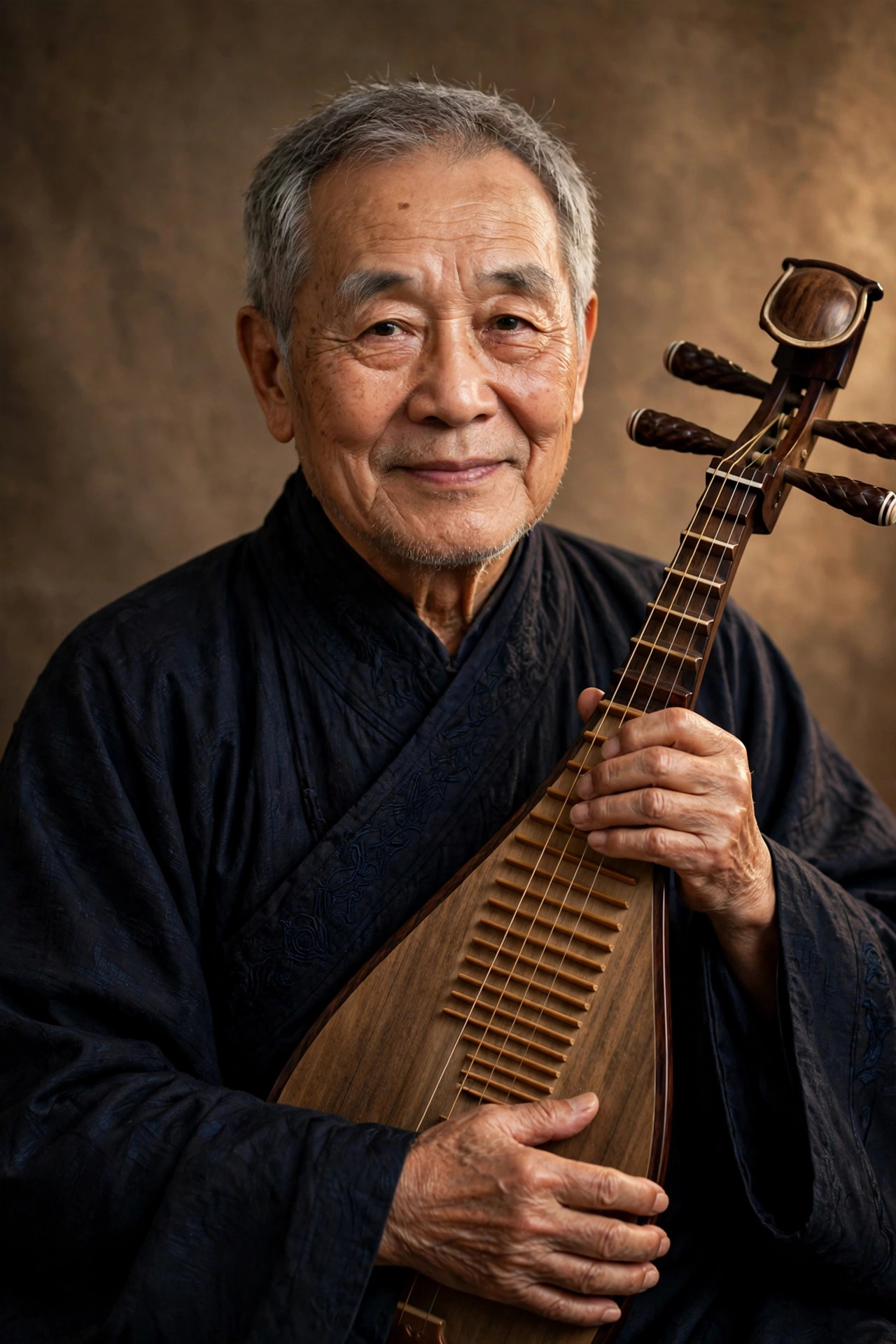
Liu Dehai was one of the most influential pipa masters of the twentieth century — a performer, composer, and educator whose artistry carried China’s most celebrated lute from village courtyards to the world’s great concert halls. Born in Shanghai in 1937, he devoted nearly six decades of his life to the four-stringed pipa, inventing new playing techniques, composing landmark works, and training a generation of musicians who would go on to introduce the instrument to Western audiences.
His career reads like a history of modern Chinese music itself. From his first lessons under the legendary teacher Lin Shicheng in 1954, to his studies at the Central Conservatory of Music, to his decades as a professor, department head, and vice-dean at the China Conservatory of Music, Liu Dehai stood at the center of the pipa’s renaissance. His collaborations with the Boston Symphony Orchestra under Seiji Ozawa in the late 1970s and his extensive international tours — more than thirty countries — made him the face of Chinese traditional music abroad.
This complete biography covers everything about Liu Dehai — his wiki, age, height, weight, musical career, compositions, teaching legacy, net worth, and ten interesting facts about the man often called a national treasure of Chinese music.
Liu Dehai Wiki and Biography
| Attribute | Details |
| Full Name | Liu Dehai (刘德海) |
| Date of Birth | August 13, 1937 |
| Birthplace | Shanghai, China |
| Date of Death | April 11, 2020 (aged 82), Beijing, China |
| Nationality | Chinese |
| Zodiac Sign | Leo |
| Profession | Pipa player, composer, music educator |
| Instrument | Pipa (Chinese lute) |
| Genres | Chinese traditional music, Guoyue |
| Years Active | 1963–2020 |
| Education | Central Conservatory of Music (graduated 1962) |
Liu Dehai Height, Weight and Physical Appearance
Unlike modern celebrity musicians, Liu Dehai belonged to an era and a profession in which personal details such as height and weight were never a matter of public record. No reliable biography, obituary, or institutional profile of the master has ever published his height or weight, and his family never released such information. As a classical Chinese musician rather than a pop-culture figure, his public image was defined entirely by his artistry — the dignified presence of an elder master with short gray hair, most often photographed in traditional Chinese scholar robes or formal concert attire with his pipa in hand.
| Attribute | Details |
| Height | Not publicly documented |
| Weight | Not publicly documented |
| Body Measurements | Not publicly documented |
| Eye Color | Not publicly documented |
| Hair Color | Gray (in later years) |
| Distinctive Features | Elderly Chinese master with short gray hair; typically wore traditional Chinese scholar robes |
Liu Dehai Career
Liu Dehai’s musical journey began in 1954, when the seventeen-year-old from Shanghai started learning the pipa under Lin Shicheng, one of the instrument’s great twentieth-century teachers. Three years later he entered the Central Conservatory of Music in Beijing, where he studied until his graduation in 1962. His talent was so evident that the conservatory kept him on as a teacher immediately after graduation — the first step in a teaching career that would span nearly sixty years.
In 1964 he transferred to the China Conservatory of Music, an institution with which his name would become inseparable. Over the following decades he rose through its ranks to become vice-dean, head of the Chinese Music Department, a full professor, and eventually a doctoral supervisor — positions through which he shaped the curriculum and standards of traditional Chinese music education at the highest level. Beginning in 1963 he also launched an international performing career that took him across China and to more than thirty other countries, earning him a reputation as the foremost ambassador of the pipa.
As a performer, Liu Dehai was a genuine innovator. He pioneered entirely new pipa techniques — including the “manually roulade,” the “double shake,” and the “three shake” — expanding the instrument’s expressive vocabulary in ways that players still study today. As a composer and adapter, his milestones were equally historic: in 1972 he participated in creating “The Heroic Little Sisters on the Grassland,” the first pipa concerto ever written in China; in 1975 he premiered his adapted version of the classic solo piece “Ambush from Ten Sides”; and in 1984 he created the “Chapter on Life” solo series, which includes the beloved pieces “Swan” and “Aged Child.” From 1977 he collaborated with the Boston Symphony Orchestra under conductor Seiji Ozawa, performing works such as the “Little Sisters on the Grassland” pipa concerto and the symphonic poem “Music at Sunset Time.”
Perhaps his most lasting legacy was as a teacher. Liu Dehai trained many of the most prominent pipa musicians of the modern era — including Wu Man, Yang Wei, Lingling Yu, and Jie Ma — students who carried the pipa to Western concert halls, film scores, and global stages. His honors included the Golden Disc Award at its inaugural event in China in 1989 for “Ambush on Ten Sides,” the 3rd High School Teaching Star Award in 2007, and the Outstanding Chinese Music Educator Award at the 8th Chinese Music Forum in 2019. He remained active until his death in Beijing on April 11, 2020, at the age of 82.
| Attribute | Details |
| Profession | Pipa player, composer, music educator |
| Career Started | 1954 (began studying pipa under Lin Shicheng); performing from 1963 |
| Known For | Master pipa virtuoso; pioneer of the “manually roulade,” “double shake” and “three shake” techniques; co-creator of China’s first pipa concerto |
| Key Works | “The Heroic Little Sisters on the Grassland” (1972, first pipa concerto in China); adapted “Ambush from Ten Sides” (1975); “Chapter on Life” series incl. “Swan” and “Aged Child” (1984); “Music at Sunset Time” |
| Notable Milestones | Performances in 30+ countries from 1963; collaboration with the Boston Symphony Orchestra under Seiji Ozawa (from 1977); vice-dean and doctoral supervisor at the China Conservatory of Music |
| Notable Students | Wu Man, Yang Wei, Lingling Yu, Jie Ma |
| Awards | Golden Disc Award 1989; 3rd High School Teaching Star Award 2007; Outstanding Chinese Music Educator Award 2019 |
Liu Dehai Net Worth
Liu Dehai’s net worth was never publicly documented, and no major financial outlet ever published an estimate of his wealth. He belonged to a generation of Chinese classical musicians who held salaried academic and performing positions rather than celebrity fortunes, so no reliable figure — estimated or otherwise — exists in the public record. Any number found elsewhere online should be treated as speculation, not fact.
His income over a career of nearly six decades came from a distinguished but traditional set of sources: concert performances across China and internationally, his long-held professorships and leadership positions at the Central Conservatory of Music and the China Conservatory of Music, and royalties from his compositions and recorded works, including his award-winning recording of “Ambush on Ten Sides.”
| Attribute | Details |
| Net Worth (estimated) | Not publicly documented — no reliable estimate exists |
| Income Sources | Concert performances, conservatory teaching positions and academic posts, composition and recording royalties |
10 Interesting Facts About Liu Dehai
- He was born Liu Dehai (刘德海) on August 13, 1937, in Shanghai, China.
- He began learning the pipa in 1954 under Lin Shicheng, one of the instrument’s legendary teachers.
- He entered the Central Conservatory of Music in 1957, graduated in 1962, and was kept on as a teacher — marking the start of a nearly sixty-year teaching career.
- He invented new pipa playing techniques, including the “manually roulade,” the “double shake,” and the “three shake.”
- In 1972 he helped create “The Heroic Little Sisters on the Grassland” — the very first pipa concerto composed in China.
- From 1977 he collaborated with the Boston Symphony Orchestra under Seiji Ozawa, a landmark moment for Chinese music on the Western classical stage.
- His adapted 1975 version of “Ambush from Ten Sides” won the Golden Disc Award in 1989 at the event’s inaugural ceremony in China.
- His students — including Wu Man, Yang Wei, Lingling Yu, and Jie Ma — became the pipa’s most celebrated international ambassadors.
- He received the Outstanding Chinese Music Educator Award in 2019, just one year before his passing.
- He passed away in Beijing on April 11, 2020, at the age of 82, and is widely remembered as a national treasure of Chinese music.
Conclusion
Liu Dehai’s life was the story of the pipa itself in the modern era. A boy from Shanghai who picked up the instrument in 1954 became the musician who reinvented its technique, composed its first concerto, carried it to more than thirty countries, and played it alongside one of the world’s greatest orchestras. Few artists have done so much to transform a traditional instrument into a living, global art form.
His greatest legacy, however, may be the one he never took the stage for: his students. Through musicians like Wu Man and Jie Ma, the sound Liu Dehai spent a lifetime refining continues to ring out in concert halls around the world. When he died in Beijing in 2020 at the age of 82, he left behind not just recordings and compositions, but an entire school of playing — a living tradition that ensures his music will be heard for generations to come.
FAQs About Liu Dehai
Q: Who was Liu Dehai?
A: Liu Dehai (刘德海, 1937–2020) was a Chinese pipa player, composer, and music educator, widely regarded as one of the greatest masters of the pipa in the twentieth century.
Q: When and where was Liu Dehai born?
A: He was born on August 13, 1937, in Shanghai, China.
Q: How old was Liu Dehai when he died?
A: Liu Dehai died on April 11, 2020, in Beijing, at the age of 82.
Q: What is the pipa?
A: The pipa is a traditional Chinese lute with four strings, one of the most prominent instruments in Chinese classical music. Liu Dehai spent nearly six decades mastering and transforming it.
Q: What techniques did Liu Dehai invent?
A: He pioneered new pipa techniques including the “manually roulade,” the “double shake,” and the “three shake,” which expanded the instrument’s expressive possibilities.
Q: What were Liu Dehai’s most famous compositions?
A: He helped create “The Heroic Little Sisters on the Grassland” (1972, China’s first pipa concerto), adapted “Ambush from Ten Sides” (premiered 1975), and composed the “Chapter on Life” series (1984), which includes “Swan” and “Aged Child.”
Q: Who were Liu Dehai’s students?
A: His most prominent students included Wu Man, Yang Wei, Lingling Yu, and Jie Ma — pipa musicians who became internationally celebrated in their own right.
Q: What awards did Liu Dehai win?
A: He won the Golden Disc Award in 1989 (for “Ambush on Ten Sides”), the 3rd High School Teaching Star Award in 2007, and the Outstanding Chinese Music Educator Award in 2019.
Q: What was Liu Dehai’s height and weight?
A: His height and weight were never publicly documented, and no reliable source has ever published such figures.
Q: What was Liu Dehai’s net worth?
A: His net worth was never publicly documented, and no reliable estimate exists. His income came from concert performances, his conservatory teaching positions, and composition royalties.
Last Updated: October 2026 | Fact-checked by the Xposed editorial team.